Think Like a Publisher 2013: Chapter Four: Production and Scheduling

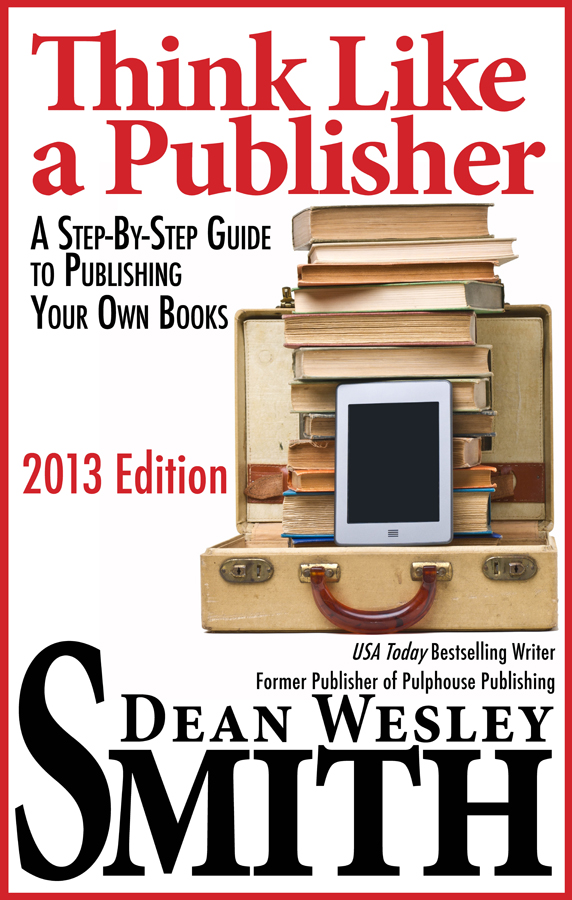
Here we go again. It’s been over two years since I wrote the first version of Think Like a Publisher. And a year since I updated it into a 2012 edition. Stunning how time goes by.

Since I wrote those first chapters for the first volume, Scott William Carter and I have taught three workshops by the same name, plus an advanced workshop helping indie writers make more money from their books. And in the fall of 2012 Allyson Longuiera and I taught a Print on Demand workshop to help writers get their books into print and learn how to sell them. We are doing the full POD workshop again in May and doing Covers and Interior workshops online now.

And during those workshops and from comments and from hundreds of sources I have learned a ton more information. The indie publishing world has gotten by the early years of the “gold rush” thinking and has now settled into a new normal that should last for years if not decades. 2013 is the first year of that new normal.
Plus the publishing company I helped start (WMG Publishing) now has a full-time employee and three part-time employees and has published about 300 different book titles. And Kris and I have started a new distribution program called Ella Distributing Inc. that will launch in early 2013. (I will announce it here.) That company already has a full time employee and one part timer and will be growing quickly over the spring of 2013.

And the overall publishing business is now stabilizing with traditional publishers holding their own and indie publishing doing great.

As traditional publishers grab for more rights and become even more difficult to work with, more and more writers are moving to indie publishing. As they make the jump, they ask basic questions on how to do it, how to be treated with respect as a publisher, and even how to do simple things like setting up a publishing business.

An indie publisher is still a publisher, the same as any traditional publisher.

Think Like a Publisher 2013 is an updated version of the book from about a year ago, including some of what has changed and what I have learned over the last year or more. I’m sure in another two years I’ll do a fourth edition. 

Every few days I will post a chapter for free here with a link under the tab above. The 2012 edition is still available in book and electronic form. After I get done with these posts and reformatting the book, this edition will appear replacing the old one. But that will take a month or so.

Comments on each chapter are welcome and help us all learn, but keep the comments focused on the topic of the chapter, please.

I hope these chapters help you get a jump on learning how to be a publisher. And on finding an audience for your writing.

Chapter 4

Production and Scheduling

The first three posts in this series were designed to be a unit and help you get set up as an indie publisher. You should have a business name picked out with a web site domain reserved, understand your upfront costs and have made decisions on how to deal with those costs. Then you should have done a rough guess on income and when each project might break even.

If I had to summarize those first three chapters, I would say this: “Be prepared, set up correctly, keep your costs down, and understand the possible cash flow.”

So the next logical step is the question: “How Do I Get My Books Out To Readers?” In other words, how do I produce and distribute my book? You can’t have distribution without production, so I am starting with production right now.

The first major steps in production are inventory and scheduling.

So to really think like a publisher, you need to understand publishing lists, deadlines, and how distribution must be planned far, far ahead of the actual launching of books.

Basic Production Schedule Organization

Traditional publishers have what are called “Lists.”

Lists are basically a publishing schedule of the books being done each month and how much attention each book will get.

In traditional publishing, the list works like this: If your book is number one on the monthly list, you get better covers, better promotion, and all the attention. And more than likely your advance was higher. If your book is in the number two or three slot, you are called a “mid-list” writer.  If your book is down in the number five or six slot, good luck.

As an indie publisher, you also need to set up a publishing schedule and then, as best as possible, stick to it. And always remember one major thing:

Publishing is an industry driven by deadlines.

Trust me, if you don’t have deadlines, things will just slip by and books won’t get done or published.

Inventory

A publishing business is a business of selling product. I know, as a writer, your story is your baby, your work-of-art. But once you move it into the publishing business it is a widget, something to be sold to readers to enjoy. You are in the sales part of the entertainment industry.

So as you start your business, you first need to know what inventory is available to you, what will be available, and what can be created.

So do an inventory. Count all your finished short stories and novels. Then count all the short stories and novels that have been published but might revert to you soon, or count stories mostly finished that would be easy to finish. Then look at your writing schedule and figure out over the next year how many stories or novels you can write.

You will come up with just a simple list. And list them by title under each category.

1) Finished Novels and Stories.

2) Stories or novels available soon. (List each with possible date.)

3) Stories or novels to be produced. (List dates for finishing…deadlines. If you have more than five or so short stories, don’t forget collections as future products.)

This total number of your inventory may surprise you, disappoint you, or scare you to death (as it did with me and Kris). But at least you have a list of inventory now.

Time In Production

In New York traditional terms, a “list” is also the number of books that can be produced every month.  They take into account numbers of employees and all that it will take to produce the number of books on the list. Traditional publishing is very good at figuring the time it will take for each step of production.

So now you need to take a hard look at how you are going to run your business.

Even if you hire everything done, it takes time. If you do it yourself, and haven’t tried it yourself yet, plan a lot of extra time for the first books because of the learning curve involved.

After you have done a few books, got a few things up electronically, you will have a pretty good idea on how long each step will take with your own work and writing schedule.

Here are the general categories you need to take into account when figuring production time.

Manuscript Preparation:

— Proofing time?

— Electronic formatting time?

— POD formatting time?

Cover Preparation:

— Finding art time?

— Cover formatting time?

— POD cover formatting time?

Launching Time:

—  Electronic Launching?

— POD Launching, including proofing time?

A couple of hints. Try a couple of short stories electronically first to get the hang of this and figure out your times. And POD times will always be factors longer, so maybe wait on POD until you get comfortable with doing much of this.

But don’t put them off too long. Paper versions are critical to reaching as many readers as possible.

Putting a Publishing Schedule Together

So now you have an inventory and a rough idea how long each project will take to complete and get published.

So take into account the amount of time you want or can afford to spend on this kind of publishing business, then just do a publishing schedule.

Set the date for publishing each title.

If you have a lot of inventory and not a lot of time, this schedule might be a couple years long. If you have little inventory and more time, you may only have a few months of schedule. And then planned books to fill spots on out.

Add in a little extra time for each project.

And then act like that is a concrete deadline.

Writers in general hit deadlines, but there are always a few writers who think it is all right to miss a deadline by a year and still expect their book to be published. And then they get upset when the publisher kills their contracts and asks for their money back. This is a business, a deadline-driven business, so act like a publisher and treat your deadlines like that as well.

Adjusting

Just as traditional publishers, don’t be afraid to adjust at the end of every month. If things are taking longer, which they will at times, adjust the deadline and shift all deadlines at the same time. But be warned:  Too much shifting will really get discouraging.

Say you did a publishing schedule for the next twelve months and wanted to get up two stories or novels or collections a month. You think that in one year having twenty-four projects up electronically would be great for your business and your projected cash flow.  And honestly it would be.

But then you start slipping deadlines and not giving the deadlines the attention a regular publisher would give them. And you discover at the end of the year you only have ten items up. You will get less than half the income and now you still have a half-year of inventory to put up that should have already been up. Not fun.

So when you set the deadlines, be realistic, don’t be afraid to adjust, don’t get in a hurry, but at the same time do everything in your power to not miss a publishing deadline.

Time in the Channel

Okay, realize that if you have an internal business publication deadline, don’t announce the exact date because it takes days for a book to come live on Kindle and PubIt and Kobo and iBooks, a month of time at least for any POD with proofing, and such. And to get through Smashwords (and out around the world) at least a month or more.

So your publication date for your internal business use is when you launch it on Kindle, Smashwords, Kobo, iBookstore, and PubIt!.

However, for the public announcement, you would be better served to announce a month later. That’s how most traditional publishers do it as well. Books are often in stores weeks ahead of the official publication date. Distribution takes time and I’ll talk about that later as well. But now, when setting deadlines, keep that in mind.

Why Deadlines Are Important

I’m going to talk a lot about this in later chapters, but for the moment, just understand that a deadline on a book being published allows you to announce the book out ahead. And do promotion on the book ahead of time. And get readers interested and expecting a book to arrive at a certain time. As readers, you all understand how this works. “Coming In May” is a powerful promotional tool, especially for a sequel to a book.

Using Production Deadlines in Your Writing

This is a wonderful new aspect of this indie publishing. You can set publication deadlines for a book far, far before you are finished with the book.

Of course, this is normal in traditional publishing. Publishers often buy two or three books at a time from an author. And when they do, they have book #2 and book #3 already penciled into a publication schedule down the road.

As an indie publisher, you can use your own publication deadlines to help drive yourself to finishing and releasing books.

Many beginning writers can’t seem to finish a project, or when they finish it they spend years rewriting the poor thing to death and having workshops turn it into a monster with an arm sewn onto the forehead.

Having a publication deadline will do wonders for getting you to write, finish what you write, not rewrite, and get it out to readers. (Wait, those sound like Heinlein’s Rules, don’t they?)

Also knowing a book has a hope of getting read by readers and making you some money does wonders for pushing a writer to write and finish.

So, when setting up your publication schedule, look not only at your existing inventory, but slot in an unfinished novel or two. That gives you a firm deadline and not only will your publishing company help you make money and find readers, but it will also drive your writing.

Summary

Count your inventory, figure your future inventory, figure your time, figure how much time it takes for each step of each project, and then think like a publisher and set a publication schedule.

And maybe use that schedule to help you finish new books as well.

Deadlines drive everything in publishing. And all deadlines are set by publication schedules.

Think like a publisher and set the schedule.

You will be stunned at how much of a difference it will make for your publishing company.


————————————————

Copyright © 2013 Dean Wesley Smith

Cover Photo by Edward Fielding/Dreamstime.com

————————————————–

This chapter is now part of my inventory in my Magic Bakery.  I’ve talked about the Magic Bakery a few times in various posts, but just think of this column as a pie and I am allowing samples of the pie here. Understanding the Magic Bakery is critical to making good money as a publisher. So I will talk about it in these chapters coming up as well.

If you feel this helped you in any way, toss a tip into the tip jar on the way out of the Magic Bakery.

If you can’t afford to donate, please feel free to pass this chapter along to others who might get some help from it.

And I would like to thank all the fine folks who have donated over this last year. The donations and the comments both after the posts and privately are really keeping me going on this. Thanks!

Tip Jar: Go To Paypal


This entry was posted in On Writing, publishing and tagged , . Bookmark the permalink.

42 Responses to Think Like a Publisher 2013: Chapter Four: Production and Scheduling

  1. John says:

    For a moment there, I struggled to understand how I can schedule when my titles will be released, when I publish them as soon as I finish writing, editing, formating, and making a cover. I really don’t know when I’ll write or finish a story. I don’t even know which story I’ll write next.

    Then it occurred to me that I am committed to published as much of my previously written (over two decades) publishable work as possible this year. I can schedule the editing (though I’ve worked with freelance editors who can take their sweet time), covers, and publishing of this previously written work. And just maybe, that is what I need to kick myself into gear.

  2. Great post, Dean. You motivated me to get really clear on what I’m planning to publish this year. If only I had some backlist to keep the titles-to-market schedule more robust while I continue to write!

    I’ve had good success with putting seasonal deadlines in my promo. “Book two in the series coming Fall 2012″ puts it out there as an expectation, but also gives you a few months’ wiggle room if needed. :)

    • dwsmith says:

      Anthea, yup, the seasonal deadlines really work. Publishers have fall, winter, and spring lists. Indie publishers should bring in summer lists as well in my opinion.

  3. RD Meyer says:

    I think that although a lot of writers could use better management of all of these areas, the biggest failure I see is in failure to build an inventory. Too many think, “I’ve got one book, so I’ll just focus on that. I’m sure I might write another book someday.”

    With rare exception, no one book will make your career. Having a stable to draw on and knowing what you can bring out down the line is crucial to being able to put food on the table.

  4. D.L. Kung says:

    Could I make a very simple suggestion to speed up the production of the POD version, especially if you’re doing a genre series or building an imprint?
    Design an interior TEMPLATE for the books in advance—decide the fonts for headers and text body, compose the title page, front matter, chapter and paragraph styles, using WordStyles. This gets easier as you build a “house style” for your imprint.
    Then draft your story from its very beginning, using the table of contents as one of your outline tools, right into the book template (rather than compose into an 8×11″ manuscript in “submssion” style expected by an agent or trad editor.)
    This is totally different from the traditional sequence of book production (which leaves the author pretty much out of the design process during lonely manuscript creation) but thanks to indie tools, now gives the author tremendous advantages in writing with inspiration and efficiency.
    From time to time, upload your working draft of Book 1 into your CreateSpace file, even though it’s not finished, to see how it’s looking on the page. If you see the POD as you’re building the story, you spread out the pressure to catch design errors or visual inadequacies over a much longer period than trad publishers give book design. What looked good in April can look wonky by June, but no doubt you got a much better idea in the meantime, and your publishing target isn’t even until autumn!
    Let your primary readers check your drafts of Book 1 using the CSp PDF printout on paper, as well as a flowable text version for their e-readers using Calibre free software (and CSp is a great way to use free cloud computing to back up your books-in-progress files!) while you draft Book 2 into the POD series template.
    By building book design right into the process from the very start, including an auto-updating Table of Contents offered by Word, you keep a firmer handle on structure and length as well as appearance, as you’re drafting. You can see already at the midpoint of your first draft if the finished first draft might inflate from 250 to 400 pages on a 6×9″ template, so you’re going to have to do something to keep your book pricing economical. Try smaller font or narrower margins. Fix design or edit down early.
    The point is, the main creative brain, the writer’s, is already on top of possible design problems during the very early gestation period when things are most easily changed.
    It’s also a good idea, for those days when you’re totally blocked with the writing, to jumpstart inspiration by working early on your series covers: work from a PowerPoint template designed for the entire series, playing with concepts, colors and fonts over many months—not weeks or days. This avoids that race-to-the-stable feeling that comes when you’re really keen to get a book into the publishing systems and don’t want to fidget with the covers any more. Even if you’re using a professional artist at the end, you’ll have a cover concept to show them.
    And when you’re blocked on Book 2, you can switch to your corkboard for Book 3 and work those index cards, inspired by printouts of your series’ working covers and page designs-in-progress. You can “feel” the series building, even when your shirttail’s caught on a pesky plot hook that week. This assumes you’re willing to withhold publishing Book 1 until your series is well underway, but the speed of my drafting system compensates for the delay. Those inevitable periods of stymied writing are shortened by visual inspiration—or at least employed on an equally important stage of the book production process simultaneous to the most creative period for the writer.
    As you say, Dean, setting deadlines is a powerful motivator, so is checking in “with your design team (yourself?)” as the project building, as early as possible.

  5. Vera Soroka says:

    This is the hardest part. Making a realistic publication schedule that will work is hard. I have finished projects but they are sitting in binders instead of being put out there. They need more work done to them first.
    I have started new projects and I am slowly editing those other projects. We’ll see if I can do this. It seems like my publication dates are very far away.

  6. C.E. Petit says:

    If I may gently, but nonetheless vehemently, disagree with the lack of a prefix in the title of this post, and explain why it’s really, really not just quibbling:

    Our Gracious Host has outlined a thoroughly sensible process for Thinking Like a Republisher. My fear — and I use that word advisedly — is that too many people are going to think this scheduling paradigm applies to initial publication. Those who do are strongly advised to read Spouse of Our Gracious Host’s most-recent blog entry on Hiring Editors and add it in to the process outlined above for previously published works. Then add about 20% interface time between the two. And pray to whatever deity/ies they worship (or Murphy’s Law if they’re athiests) that they can come somewhere close to that.

    Too, one should keep in mind that Our Gracious Host and Spouse of Our Gracious Host are talking only about the publishing process for works of commercial fiction that are not romans á clef like Primary Colors. For just about anything else, an initial publication needs to add at least a “passes the laugh test” phase for legal review and permissions in there — even just saying “Well, I only used one line out of that song as a chapter header, so I don’t need to get permission from the songwriter.” The point is that these are conscious decisions, not just “I’ll throw it at the wall and hope it doesn’t stick.”

    Particularly for those coming to the concept of “deadline” from many other fields and parts of the entertainment industry — a deadline is a target. Miss the target too often and that indicates that one needs to rethink the process of how one sets one’s targets… but a failure or three to hit the target does not mean that those projects or three were commercial failures that require rending of one’s authorial hairshirt and acceptance that one has brought shame and disgrace upon one’s family for generations to come. As a specific example in republishing of works, consider how to republish a work that got cut for length by its original publisher… and for which the author disagrees with the cuts. One can’t just add the omitted material back in for the Author’s Cut; one must still edit it for consistency with what was done for the published form (example of when that was done poorly: Apocalypse Now! Redux, with all of the lighting and story and characterization and soundtrack continuity errors), or perhaps revert to an earlier draft of the published form and reedit from scratch (example of doing that poorly: the so-called “director’s cut” of Aliens). And that’s just one example.

    The key point that I’m making is that deadlines (etc.), as useful as they are in the aggregate, are almost meaningless for original publication as anything more than milestones when one is managing a specific project. And that’s why I believe that Our Gracious Host’s title for this post is unintentionally misleading.

    We now return you to your regularly scheduled Super Bowl pregame show.

    • dwsmith says:

      C.E., we disagree, which is fine. For over thirty years I have been writing original fiction to deadline. And a ton of it would not ever have existed without the deadline. So I stand by my title. (grin) Deadlines work just fine for original fiction, and, of course, they are called “lists” worked on years ahead by traditional publishers. But they all have deadlines as well.

      Never ever said that the time it takes to have a copyeditor in the mix should be ignored. Some editors (not acquiring or content editors) are required in the process and should be worked into the time.

      But my definition of a fiction writer who doesn’t like or follow deadlines: Broke.

    • Dude.

      How DARE you suggest that the Director’s Cut of Aliens is anything less than FREAKING AWESOME!

      Of course, that movie is made of nothing but awesome, by definition. But still… Those autosentry-thingies are kick-ass!

      Seriously, man. What movie were you watching??

      :)

    • Mercy Loomis says:

      I’ve actually had good success with publishing both reprints and new fiction to a schedule. I made a goal in 2012 of publishing at least one item a month. I set up my schedule so that I was publishing an Aether Vitalis story, then a Just for Kinks story, and then a miscellaneous story. So I needed four of each for the year. I slotted in the ones I had rights back on, and wrote the rest to deadline.

      For over 12 months now, I’ve had a new ebook launching on the first of the month. (Submit to Pubit! two days before launch date, Kobo two days before but you can set the launch date ’cause sometimes they don’t take as long, Amazon the day before, and Smashwords the day of. I’m not submitting directly to iTunes yet.)

      I have beta readers who help me edit, but I tend to write pretty clean copy. Listening to the book with text-to-speech helps me find those pesky missing words.

      Of course, this has worked great for shorter pieces, but so far I have not been able to apply it to novel writing, as I had said to myself “I’ll just work in the novel writing in between the shorter peices.” Yeah, not so much. So I need to set a solid deadline for the novel this year. Autumn is usually good for novel releases, right? September or October?

  7. Teri Babcock says:

    “Could I make a very simple suggestion to speed up the production of the POD version”

    D.L. Kung, I think your suggestion is genius and I thank you for making it. It had never occurred to me to take that approach, which I think creates an integrated, ‘wide-gaze’ relationship with the fully finished work, as well as preventing grief and pain :)
    I’m going to try it.
    Thanks again.

  8. One bit of good news on the scheduling front for indie ebooks… Times seem to be improving.

    I announced that I’d be launching the first episode of my Starship serial January 31st. To make sure it was uploaded by then, I put it up on the 29th. Amazon had it up twelve hours later. Kobo took six. Draft2Digital took six hours to get it on B&N, and 24 hours to get it on Apple.

    I did two more tests and got similar results. Now, maybe it was just good timing… But it’s possible these services are beginning to reach new levels of efficiency, too. ;)

    I’m releasing new episodes every week for the next four weeks, still giving 48 hours just in case. We’ll see if I actually need that much lead, or not…

  9. D.L. Kung says:

    I fully concur with Dean that deadlines/targets are essential for new projects, not just republishing, and the ‘wider the gaze,’ (yes, Teri!,) the more momentum the writer enjoys moving towards those landmarks on the road. It’s one of the biggest advantages to switching from trad to indie that I’ve discovered so far.

    Let’s face it, the 8×11″ submission manuscript format is a time-wasting DINOSAUR that only retards the production schedule. Bringing in design only at the very end of the project is an antiquated practice linked to last-century reliance on outside offset typesetting companies. It’s absolutely unnecessary now, whether you’re working alone or with a team.

    But sadly, I’m no genius, Teri. The writing-straight-to-template idea is hardly new—it’s already proven practice for swifter, surer production towards very, very, very hard deadlines.

    Where?

    I spent over twenty years as a journalist for major news weeklies I promise you’ve heard of. We reporters knew that while we interviewed, and drafted our inches of copy in the field, other people in London or New York spent that very same week mocking up covers, laying out pages and reserving for our reporting files the approximate space we negotiated with the news editors at the beginning of the week’s news cycle. Things were flexible, but if we asked for two columns at commissioning on Friday, it was unlikely anybody would be pleased if we turned in six columns’ worth of reporting the following Tuesday noon.

    That’s how a 80-page news magazine gets ‘built’ in a single night, every Thursday after Wednesday’s editing, right on deadline. We were all working into a template of length and style that was waiting for the text to be edited and laid in between the ad pages sold in advance, e.g. the obituary page at the end always looks the same from color bar in red, headers, sub-headers in bold font, and photo at the top to length.

    In London, they still call the work-in-progress ‘the book,’ rather than ‘the magazine.’

    Right now I’ve got three corkboards on my desk, with indexed sequence breakdowns and one page working outlines, test covers and evolving TOC’s printed out. All the fiddly front matter, author’s bio, ‘other books by,’ glossary, dedication page and title pages are done for all three from my series template and lacking only the ISBN numbers to plug in— just the way my old employers’ mastheads, table of contents pages and back matter were already pre-designed by graphics experts years in advance with the in-house layout editors.

    My outside copyeditor also prefers to have the final page size in front of him as early as possible in the editing. It shows up errors with hyphenation and accidental double spaces, orphan sentences and ‘blobs’ of too much dialogue or chunks of description earlier in the process, too. Editing using flowable text using an e-reader early on offers similar peeks into hidden hitches on e-books.

    The closer you move your creative revisions to the finished formats, the more production problems you’re spotting on the way to those deadlines. To novelists who find this template idea constricting, I might point out that most artists, from theatre and film directors to sculptors to sonnet writers, know their perimeters from the get-go.

  10. D.L. Kung says:

    Thanks, Allynh, so I revise this: “You can see already at the midpoint of your first draft if the finished first draft might inflate from 250 to 400 pages on a 6×9″ template, so you’re going to have to do something to keep your book pricing economical. Try smaller font or narrower margins”
    (to add)
    smaller font, narrower margins or a larger trim-sized template.

  11. I like the idea to write in the POD template. I’ve had something like this ticking around in the back of my head as I go about formatting my novel for print, but it hadn’t clicked. Thanks, D. L. Kung! Maybe I’m not so crazy after all. ;)

    And it makes perfect sense, because I’d already decided to use the same fonts and layout for subsequent books in the series. Something else I was flirting with was the idea of building templates of different styles for different genres, ready to drop the book into. Now I’ll do that, but write the book there from the beginning, and see how I like it. Nothing ventured, as the saying goes.

    I always learn something on this site. Love it. :)

  12. This question is probably tangential and may or may not be addressed elsewhere on your blog, but I’m making a rough production schedule and I was wondering if you had any thoughts about optimal length. In the time it takes me to write a 100,000 word novel, I could write 5 novellas or 20 shorts (and 4 collections). Now, I can charge more for the novel and longer works appear to sell better, but is the return on investment enough to justify the additional 4-19 titles I could have written during the same time period? All other considerations being equal, what length work is the best use of my production time?

    (Yes, obviously, a story’s length is dictated by story needs, but I have titles planned for any length, and would prefer to focus on what’s best for my earning potential)

    • dwsmith says:

      Michael, honestly, I’ve touched on this a few times in different fashions in my New World of Publishing series, but I think I’m going to hit it again in a new post because, to be honest, it’s a great question. And an important question.

      So give me a few days or a week and I’ll have a long post on this. Thanks for bringing it up (I think. (grin))

      • Hey, if you consider it an important issue I’ll go on and feel good about myself for dwelling on it. You’ve got my head full of return on investment and opportunity cost.

      • Liana Mir says:

        Thank you! It gets me wondering sometimes. Though I often opt for shorter works because I know I’ll be able to finish them faster. I’m not a seat-of-the-pants writer for novels. I need to let them sit in my brain on a back burner for spells until I can move forward on them. Short stories, I can just push.

      • Oh, good! Like Michael, I have stories of varying projected lengths that I’m eager to write. I’ve been focusing on those around 10,000 words, because I can build my list of titles more quickly that way. I’d been thinking I should switch over to longer works at some point, because they do sell better. But when? And is that strategy valid?

        My current idea is to finish WIP and 2 more short stories, all written around a similar theme and intended to go into a collection of 7 stories (4 already written and published as solos). Then write a 20,000-word story, next a 60,000-word one, and then maybe move on to one of the 150,000-word door-stoppers I want to do.

        I’ll be very interested to learn your thoughts on this issue.

        • dwsmith says:

          J.M., almost done with my post on this topic. But I stand by my standing instruction as one writer to another, write what you want, what makes you passionate, and then figure out how to sell it after it is done. But I am doing a new chapter on “Think Like a Publisher” on this very topic. A couple of days.

          • I’ll look forward to the post!

            My quandary is: if I’m passionate about a story likely to run to 10,000 words, but equally so about one likely to run to 50,000 words, which should I write first? Perhaps it does not matter! But I’m interested to hear your detailed thinking on the issue.

    • Jason says:

      Michael, I’ve been thinking about the same thing. I think that shorts don’t sell as well because people want to be taken on a journey.

      My thesis: As long as you take readers on a well-defined journey — usually consisting of eight sequences — the length of the novel doesn’t really matter. They’ll keep buying anything that makes them feel like they’ve escaped their own often miserable lives.

      Example: I’m getting great reviews on a new 50,000 word novel. I hit all eight sequences, and all the same plot points, that a 100,000 word novel would. Modern readers seem to really, really appreciate the quick pacing, accomplished through figurative descriptions. Best of all, it only took me about 80 workhours to write, with a few more for editing afterwards. (I hope to increase that speed soon.)

      My hunch is that this shorter, faster, punchier style translates better to an e-screen. Think of it like a really detailed synopsis of a longer novel — except that the synopsis IS the novel. Of course, those writers who hide their lack of plotting behind windy descriptions will find this new paradigm impossible to work with.

      So to answer your question: My own style, going forward, will be four 50,000 word novels per year. I can charge $4.99 for each novel. As long as that eight-point journey is undertaken, readers should (and do) feel satisfied.

      No short stories, though. It’s impossible to give people that same sense of emotional engagement in <7000 words. It seems to me that shorts are a more cerebral format.

      Caveat: I don't read or write fantasy. My hunch is that those readers — who in my observation rarely cross over into reality-based fiction — will continue to demand their 200,000 word doorstops.

      • Mark says:

        Two questions for you Jason:

        When you say, eight sequence, is this a mandatory thing for 50k word books? Could you have a success with say, six sequence? What kind of sequences–action? first kiss? shootouts? bad guy gets killed?

        Secondly, why write a 100k novel when you can write two 50k word novels and get a better return? Or is this something in the fantasy genre, like LOTR?

        I am writing my second novel and aiming for a 50k word count, but now halfway in realize I just can’t tell the story I want to tell without upping it quite a bit. Say, 70k. I don’t know if it is just the way I plot things or what. I try to stay away from excessive descriptions, but sometimes you just have to go deep for some scenes.

        • Liana Mir says:

          He means the eight sequence story structure common to screenplay writing.

        • Jason says:

          Hey Mark, the eight-sequence theory of storytelling has been around for decades. I had been a scriptreader in Hollywood for a couple years when I decided to take my first creative writing class, which was taught by a VERY famous comedy screenwriter. The first thing he said was “Don’t make it funny” (which was a real eye opener, but he meant use situational rather than verbal humor). The second thing he said was “Master story craft instead”.

          We scripted out our stories on dry-erase boards using the eight-sequence structure. Yes, it’s rote, but I learned that a mechanical view of plotting is an excellent foundation for capturing and using those flashes of right-brained inspiration when they invade your brain. I also caught a lecture on story given by another verrry famous writer/director (cough*HungerGames*cough) who said that theme is everything, that characters only exist to serve the theme, and if that they aren’t, to eliminate them. He mocked writers who wait for their characters to speak to them.

          IMO, the best book explaining the eight-sequence structure is Rock Your Plot by Cathy Yardley. It’s very short and direct.

          And yes, my point was that writing two 50K novels is financially more rewarding than writing a single 100K novel. We charge the same $4.99 either way, right?

          But I don’t think shorts are the way to go, unless you’re really comfortable making two or three covers a week and coding the ePub files and laying out the InDesign files and constantly dealing with Meatgrinder and constantly uploading to all the sites, etc. I know Dean says it’s easy, but it’s still a lot of technical hassle, which isn’t for most of us liberal arts types. IMHO, the 50 K novel is the perfect balance between maximum yearly productivity and maximum price and minimum need for technicality.

          Our esteemed host may disagree…

          • J.A. Marlow says:

            I don’t know about the pricing tiers of others here, but no, I do not price the same for a 100k novel as I do a 50k novel. Not even close. Longer novel = higher base price (within limits).

            But then, that’s the business side of this. Coming up with a pricing structure/tier that works for you, while keeping an eye on the market.

      • Mark says:

        Oops, didn’t see that last part about not reading/writing fantasy. :)

  13. John Walters says:

    Concerning storytelling sequences, one book that helped me in plotting is “Story: Substance, Structure, Style, and the Principles of Screenwriting” by Robert McKee. Though ostensibly written for screenwriting, it is full of great tips to tighten your writing. He writes of film as classicly divided into three acts, as I remember, though some have more depending on the specific plot. I found that when I consider my novels (as well as novellas and some fairly long shorter works) in this light (that is, in a three-act framework from which of course I can add or subract according to need) it helps me visualize plot points, cut excess, figure where to start and stop, and so on.

    • Jason says:

      Three-act structure never helped me, John — it’s simply too broad. It’s like trying to wear a glove with only three fingers.

      The eight-sequence structure fits storytelling far better.

  14. D.L. Kung says:

    Every production line has stepping stones for smooth progress towards deadlines.

    On plotting, I kinda mix it up using three-act breaks, eight-sequence breakdowns, “The Hero’s Journey” from Wheat’s “How to Write Killer Fiction”, the “Forty Plot Points” from an online workshop and a little touch of the five-act structure from Shakespeare. I especially find McKee useful on the dynamic energy required of dialogue, opening gaps and closing gaps between characters.

    But you can come up with other unique paths. (One of my social comedies, “Love and the Art of War” was structured around the ancient Chinese warlords’ 36 stratagems of warfare, laid onto three acts, which gave me a great grid on which to hang the characters’ storylines.

    Mark all of these “aids” out on a corkboard laterally divided into three sections, and then play with index cards for variations that hit the right midpoints, turnings and climax points. It’s FUN. Then add flesh to the bones with Excel spreadsheets to lay more track, with new columns for setting and moods, motifs and symbols, recurring themes, scene dynamics and key points of dialogue as they occur to you.

    Trust me, you are writing as your story evolves in amazing ways, and you aren’t wasting time, but avoiding so much crumpled paper on the floor. It’s easier to fix bad scene flow in a creative stage than after writing 50 pages of ‘featherdusting’ stuff just to find your way to the story. I’ve tossed lots of index cards without grief.

    As I said above, lay this working, morphing outline into your book template and use Word’s auto-updating Table of Contents in the form of inspiring chapter headings as your basic spine. On a printout of the TOC take note of the approximate page numbers where you should be landing (a screenwriter’s habit) to guide you. Then lay all the info from your index cards, including the research it linked to, if possible, right into your book template for the corresponding chapter. That’s really important for historical fiction.

    Print out all these weeks or months of thinking only when you tackle an individual chapter, to help keep focused. Target drafting maybe two chapters a week. Reread your chapter notes and all these ideas you’ve had, with a clear idea of what that particular chapter has to do for the reader. You’re sure to get more ideas, so make notes on a spiral binder marking out the elements of the 2-3 scenes from the spreadsheet that will do the trick for that chapter. ONLY THEN draft a chapter. You’ll find that, far from being blocked, you have three or four different ways of getting from Chapter 11 to Chapter 13, and a whole range of choices.

    I wasn’t surprised when Agatha Christie said she spent years jotting notes for book ideas, (these notes have been compiled into an entire book in itself) at least ONE YEAR plotting a single, slim mystery, and only a few weeks writing the thing. Whatever you think of Christie, she was a powerhouse of production, meeting deadlines and crafting tight stories that continue to delight fans.

    By the time you tackle a 300 page novel, after this kind of groundwork, it’s like watching a favorite story that’s already living in your head. It also helps to spot big gaps in your story development earlier than sitting at Chapter 17 going, “oh, oh, what next?’

    This, I think, is the key to meeting deadlines and sticking to production targets. Of course, life intervenes, but the whole book doesn’t slip away when delays or family needs break the flow.

    • dwsmith says:

      Well, as I have said many times before, every writer is different.

      If I had to do all that for every novel, I’d never be a professional writer. But again, that’s just me. I type in a title and write the first line and entertain myself. So I’m not endorsing your method. I find it interesting.

      And some of my best friends outline like that or in other ways as complex. And I did a 135 page “well-realized” proposal for a thriller once. So I am not one to talk except to say, “Every writer is different.”

      And I have discovered that every novel along the way has been different. All one hundred and some of them.

    • Carradee says:

      Hmm… If I may further illustrate the “every writer’s different” thing:

      Outlines stymie me. Always have, even in school essays. Whenever I had the freedom to write an essay without writing an outline to go with it, my grade was better than when I had to outline it first. And the essay was easier to write.

      That doesn’t necessarily mean I don’t plan whatsoever. I plan…sometimes, sorta, in scribbled notes that don’t make sense to anyone other than me.

      I have both a questionnaire and a loose “template” I’ve been using for short stories, but they’re more aids that help me avoid certain “stuck” spots. (I’ve discovered there are patterns on where I tend to get “stuck”.) Though I’ve found the questionnaire and template useful for several stories, they’re just tools in my toolbox. I don’t use them when I don’t need them.

      Hammers are great for pounding nails into a wall, but not so great for pounding bread dough. And then if you’re dealing with a screw—well, you handle that another way entirely. :)

      Also, I’ve found that when I plan things too much in my head, I end up missing something important and getting stuck for quite some time trying to figure out what I did wrong and have to scrap the planned-out scenes, while when I plan less, my “stuck” times mean I need to figure out how to get from point A to point B, rather than what needs to be deleted from point A and changed in point B. And in that unplanned situation, my “stuck” time doesn’t last nearly as long.

      What’s helping me most as a writer is paying attention to when I need planning and when I don’t. Planning when I don’t need it hurts me—and refusing to plan when I do need it likewise hurts me. Key for me is being willing to flex and adapt my toolbox to suit specific situations.

      But that need for variety suites me overall. I know others who seem to do well by sticking to their specific tactics. If that works for them, great. I just know that doing the selfsame thing all the time would drive me up the wall.

      Again, writers differ. Nothing wrong with that, but insisting that a single method will help everyone is silly, in my opinion. Sure, there are some tactics that hinder more folks than they help, but I don’t that means they hinder everyone.

      Frankly, D.L., while I wouldn’t be adverse to setting up a story with a specific structure—I’ve done it—the plan’s always a loose “base this on X”. I might include some ideas of what that section will end up looking like, but it’s ended up being a waste of time every time I’ve planned out a story in detail before I sat down to write it. I ended up trashing too much material and got stuck for too long unraveling where things went wrong. *shrug*

      Now, after I’ve gotten to the midpoint on a story, I might sit down and hammer out how I’ll be getting to the end. But that’s not the same. :)

  15. D.L. Kung says:

    Maybe I should have added, that the “plan,” or “outline,” at least for me, never stops evolving at any stage of the process. I think that’s been misunderstood above, because if you’ve planned in a level of detail that’s too ahead of the development stage— that whoops! you’re actually writing, not creatively jostling with options—you’re writing too soon, and of course you’re going to be trashing stuff and unraveling.
    Nowhere did I suggest that the evolving work should turn rigid or constricting. Whatever works, guys.
    As Dean says, every writer is different and every project, I might add, can be different. I’m not talking about short novels or novellas. I’m working on a trilogy of historical novels, 300 pages plus each, set in late Rome. I need to see character arcs over a five-year time frame, to have set ups and pay offs stretch over those arcs, have a lot of research at hand, and to keep a good handle on structure. Of course new things crop up, but they’re working fine. I’m building the glossary and place names list for the reader into the template as I go to save that tedious chore of looking it all up again afterwards. (faster production)
    The first draft of the first volume, 360 pages, took only a month, and the second will finish in March around the same length. I’ll finish the third by June. Thats 900-plus pages in six months, for anyone thinking “production.”

    This post being about production and deadlines, I’m just suggesting that you can avoid a lot of revisions by doing the first two or three think-throughs not in the form of writing whole sentences and paras, but in massaging the elements earlier so the whole thing feels really solid and wrong turns don’t make it all the way to sentence or para form. If some writers can only think on the page by actually writing out each full sentence instead of an index card, fine, but I’ve learned a lot from the film industry approach. Hitchcock storyboarded every damn camera shot before the sets were even built. My template idea came from twenty years in the news magazine business.
    btw, I’ve done novels both ways (published by Carroll&Graf and Orion as well as indie) but I found that the mysteries took good planning to work and the literary fiction was richer for it.
    Just offering a different way of handling meeting your deadlines and saving time.

    • dwsmith says:

      D.L. Kung said, “I’m just suggesting that you can avoid a lot of revisions…”

      Why would you need to rewrite? Have you been reading my blog over all these years? I think rewriting for most writers is death to a story. And I think going over an outline that many times would bore me to tears as well and make me lose interest in the story.

      Again, every writer is different. I can tell you that if I wrote like you are suggesting, I would have quit after a few books way back. I hated outlining of any type when forced to do it by my publishers.

      And when forced to outline, I would tell the publisher in a page or two how the book opened, then say something like “In the center there will be a lot of battles and problems coming to a head in a big climax scene.” And then tell them how I thought it might end, if nothing in the middle changed anything. Usually about 800 to 1,000 words for the entire outline. Sold a ton of books with that method and never looked at the outlines again when writing the actual book.

      I am trying to be clear here just so people don’t take what you are saying as some writing method I back as a way of writing. I do not. I can’t even imagine it working for me. And it plays into so many myths of writing taught by English teachers, it scares me, to be honest.

      But it works for you, clearly. And that’s my point. Every writer is different.

    • Carradee says:

      Nowhere did I suggest that the evolving work should turn rigid or constricting. Whatever works, guys.

      Precisely. ^_^ My point was that for me (and some other), any outline will end up being rigid or constricting. Once I have things slotted in a numbered outline—especially a numbered sentence outline—I can’t see it any other way.

      Thus why, though I’ll play with outlining methods, I never, ever use a numbered outline. Or even a sentence outline. ^_^

      I have had (school-age) writing students who worked best from outlines, and I’ve made sure everybody could make them, because so many teachers demand them for school essays.

      And just as a reminder: There are a few possible meanings for “rewrite”, “revise”, and “redraft”, some of which overlap or contradict each other.

      Personally, I think cleanup revisions are good, while revising for the sole goal of improving the story might not be so good. (Depends on a lot of factors; often it hurts a story, but I’ve seen cases where it helps.) I’ve rewritten scenes (taken the original and changed something about what happens, usually because I had setting or motive off in the first round), and some might call that revision rather than rewriting, but I don’t think it would be redrafting by any definition.

      And then “redrafting” (taking the old draft, tossing it out, and starting anew) might also be called “rewriting”, but I doubt anyone would call it “revision”.

      I don’t know that you two, D.L. Kung and D.W. Smith, are referring to the same thing when you say “rewriting”, but I don’t know that you aren’t, either. *shrug* Fact is, I’ve seen things that have been edited/revised/rewritten to death, and they make me sad. I’ll sometimes find gems peeking through of the writer’s original voice, but obviously the writer (or an editor) has pulled the vast majority of it out of the writing…and the end result is rather bland.

      Now, bland writing is good in some contexts. And there’s such thing as an attempt at voice not working (as when a writer mixes metaphors in ways that don’t work). But overall, bland writing is…bland. And it ultimately makes the writer forgettable.

      In my opinion. ^_^

  16. D.L. Kung says:

    P.S. Sometimes when I talk to other writers about working from outlines, I find out that they only wrote one outline or plan and thought that their “outline” stage was done and dusted, then were surprised (shocked, I tell you!, shocked!) that a whole lot more creative change came after that.
    That is definitely not what I’m describing here.

  17. D.L. Kung says:

    Yup, I’ve been reading your blog for about two years and it’s great. Nobody’s going to confuse my comments with your great posts or any endorsement, I think.

    Personally, I benefit a lot from revision, especially tightening dialogue for dramatic effect and “voice,” and cutting descriptive flab. I don’t produce my best sentences straight out of the box. My bad.

    Actually, I don’t know anything about English teachers or creative writing classes. I was raised by a film director father so I’m familiar with storyboarding, worked in radio news writing (no time for revisions there!) and then spent twenty years of writing to magazine space, (Economist and BusinessWeek, etc., ) so I’m familiar with space and time parameters, after which I then raised three kids to adulthood. So I’m used to juggling projects at various stages of development simultaneously with limited writing time! :)

    I’m just offering some alternatives, Dean, borrowed from my experience in other industries, that are working better for me now with novels. It might help some people who can’t set deadlines and manage production by just sitting down to a blank page. You’re quite experienced, so you know the piste, so to speak, but others with less of a track record might be a little confident of that. If you say every writer is different, then why not us toss these ideas out there without referring to being scared or myths?

    You mention hating writing to outline for publishers. I would, too! Yuck to answering to others when you’re the creative boss. Answer only to oneself.

    And it’s your blog and we all love it. If anyone can lay it on the page to satisfaction from the get-go, more power to them!

    btw, if you feel that sharing my comments might mess up your message to your readers, don’t publish them and no hard feelings. I’m only trying to open up the options.

    • dwsmith says:

      Oh, heavens, no, D.L., I appreciate your comments and love the aspect that it shows there are more ways than one to do this. So please, keep posting as much as you want. I love your comments and I am sure people are learning from them. Just at times I need to be clear for me. (grin)

      As for producing great sentences out of the box, the difference is that you care and I don’t care about sentences. I only care about story, story, story. I could not care if a sentence is good or bad if it helps tell a good story.

      Also, I believe that when you are “tightening” and “cutting descriptive flab” you are not helping your story but likely hurting it. I believe the back of our brains knows more about writing than the front of my brain by a long ways, so what it puts down I leave alone and trust.

      That is our difference. I never look back and just trust what I have done in telling a story.

      Again, thanks for the time to comment. Always great fun, even though we don’t agree on all the details. (grin)

  18. Marian says:

    Please make the picture of your book a link so we can buy it!

    • dwsmith says:

      Marian, thanks for the interest, but right now the book in the new edition isn’t done or out yet. However, when it is, Ella Distribution will be handling the paper edition for bookstores and it will also be available online in all the normal electronic editions. And if you haven’t checked out Ella Distribution yet, might want to give that a look. http://www.elladistribution.com

      Again, thanks for the interest. I’ll get that thing done pretty soon, I promise.

Leave a Reply

Your email address will not be published. Required fields are marked *

You may use these HTML tags and attributes: <a href="" title=""> <abbr title=""> <acronym title=""> <b> <blockquote cite=""> <cite> <code> <del datetime=""> <em> <i> <q cite=""> <strike> <strong>